

Fact-Checking the Disinformation Warriors
Notes on "Attack from Within: How Disinformation is Sabotaging America," by Barbara McQuade
We get the word jacquerie from a peasant revolt arising from the aristocracy’s unilateral and undemocratic changes to the social contract. Froissart, who had no sympathy, accused the peasants of terrible atrocities, roasting gentlemen on spits and forcing their wives to eat them, among other things.
What stands out in all accounts is that the peasantry was more keen on resisting the English than the nobles. It wasn’t that they didn’t want to fight, it’s that they did. Despite a general amnesty, the French crown was unable to prevent the inevitable and ruthless reprisals, often having nothing to do with the original alleged crime. Was Froissart a disinformationist? Or was the crowd stirred up by disinformation?
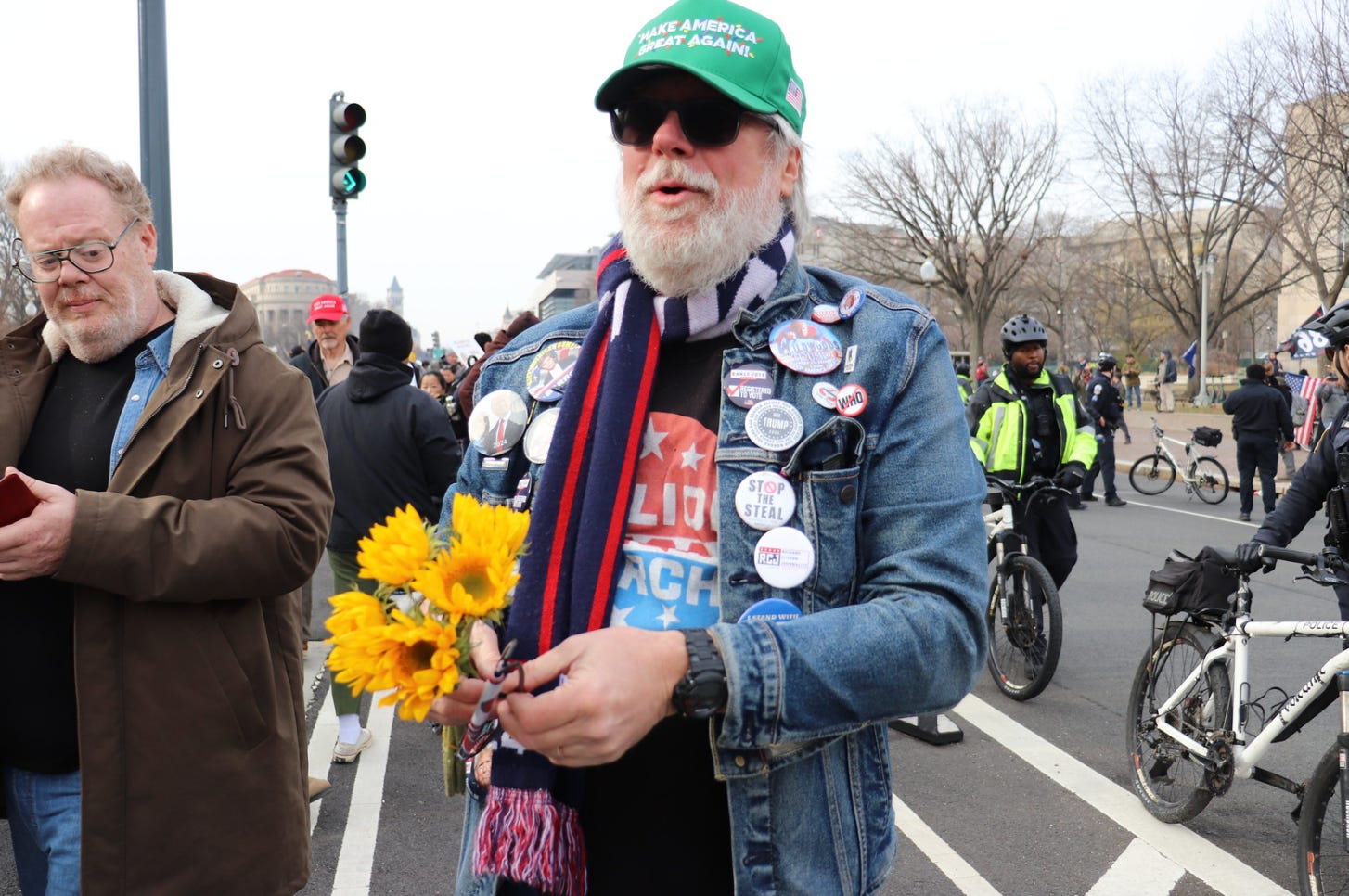
The January 6 jacquerie arose from a lack of trust in electoral systems due to unilateral and undemocratic changes to the social contract, both with respect to the election itself and the decision to violate fundamental liberties with a historically unprecedented and economically ruinous nationwide lockdown. As in medieval France, the main accusation of the peasantry against the nobility was that they had abandoned the crown. Barbara McQuade thinks January 6 happened because of disinformation, which is something the jacques might have heard from a canny member of a decadent oligarchy in the process of losing popular support, who’s trying to calm things down.
McQuade’s record stands well enough on its own that she didn’t need to write this infantilizing book. What it actually shows is the skills of a prosecutor are poorly suited to the grey areas of propaganda, and the constant manipulative language will persuade no one save the dwindling choir of MSNBC viewers to whom she is preaching. It’s because she is a good prosecutor that one should be troubled by this paranoid turn inward. If she aspires to higher office as prominent U.S. Attorneys often do, it’s too bad, because this book has given voters cause for a great deal of skepticism.
McQuade uses the phrase “election deniers,” one of the stupidities that took hold everywhere after the 2020 election, akin to calling someone who thinks the moon landing was staged a “moon denier.” Perhaps there are one or two people, up in a holler somewhere, who think all those images of polling places were generated by AI, but most of them think something was wrong with the election, not that it didn’t happen. Most people who think the moon landing was staged don’t also think what rises in the evening is merely a large hole in the firmament.
So we might even say Mrs. McQuade has gone further than the standard invidious bad faith of her political persuasion, and crossed over into doing some misinforming, or heaven forfend, disinforming, herself. Better suppress her, and if she does it too many times, perhaps we could charge the habitual misinformer with a crime. If she wants to learn her lesson, she might consider that “the essential need for truth in self-governance” encompasses a fair representation of what the other person thinks.
As a prosecutor, McQuade knows better than anyone the various standards by which it is usually necessary to prove facts, as well as the problems of attribution, which are greater in the world of media than they are for most crimes. That she has not lent her expertise to this problem is the tell this is a book written to elevate her profile, not to engage the reader in a matter of public interest.
The first paragraph of the first chapter begins by telling us Joseph Stalin “got his start in the communication business,” as a “writer who learned the power of messaging.” I spit out my coffee and wondered if she was putting me on. “After the Bolshevik Revolution in 1917, Stalin ran Pravda,” she tells us. This isn’t true either—he was running Pravda before the October Revolution.
In fact Stalin’s reputation among the bolsheviks preceded him because of a heist in Tiflis a decade earlier, something the Russian liberals probably considered disinformation. If an American had spoken too loudly about all that during the latter reign of her fellow Democrat FDR, he might have been suppressed by the Office of War Information; not so for commentators seduced by the dark-eyed Georgian bank robber.
This book was published before the 2024 election, and it offers a just-so story typical of Obama-era popular nonfiction—a collection of historical anecdotes, most of them unrelated or specious, that one is supposed to feel an association to and with one another. It has more in common with pop psychology books than political science ones; things like “confirmation bias,” “stubbornness,” “amplifying fear,” are ascribed as if the author, again, a prosecutor, has the electorate on a chaise lounge. I am persuaded that Facebook is harmful to the demos; where Mrs. McQuade’s expertise is required is in advising how best to put Sheryl Sandberg in prison.
You could use McQuade’s book as a sort of Zen exercise in how to think clearly, through the presentation of the opposite of clear thought. Consider this paragraph:
The nonstop narrative of government misconduct can create the impression that the government is mostly dysfunctional and corrupt. In fact, I know from my own career in government that the opposite is true. But a report that on a given day, a government employee capably performed their job is hardly newsworthy. When we are constantly bombarded with stories about government misconduct, people are more likely to believe antigovernment disinformation. This exposure leaves us susceptible to crusaders like Steve Bannon, who has argued for the ‘deconstruction of the administrative state.’ The ouster of Kevin McCarthy as House Speaker by the far-right faction of the Republican Party in October 2023 sowed chaos in Congress, further eroding public confidence. Research shows that only 29 percent of Democrats and independents in the United States trust government, and only 9 percent of Republicans do. Distrust in government makes people skeptical when the government tells them they should wear a mask or get a vaccine, creating unnecessary risks to public health.
If only we hadn’t, through wholly lawful means, gotten rid of the House Speaker whose brother-in-law scammed the Navy by pretending to be an Indian, people would get their vaccines and trust the government. Is there some significant group of people to whom this makes sense? In fact, Americans’ baseline trust of government is low, and always has been. This book was published, again, before the 2024 election, and we might consider that the subsequent exposure of rampant defrauding of taxpayer funds has vindicated the public’s skepticism.
We get to the real point of the book somewhere around the halfway point, where we might expect a more complete explanation for how all this disinforming harmed democracy. The stuff that sounds persuasive has since turned out not to be—Douglass Mackey has been acquitted—and the stuff that’s worth a closer look would put her on the outs with NBC if she did so she doesn’t, like Psy-Group, the Israeli company that probably ought to be prosecuted and even Bob Mueller wouldn’t touch. She says nothing more than a line from their sales brochure, “reality is a matter of perception.”
When it comes to the actual elections, there are two questions: do people trust them? McQuade thinks too many people don’t and they should. Fair enough. But if I’m going to read a book, especially by one with a long record as a practitioner of law, I want to hear her answer the question, is it trustworthy? No doubt lots of people believe false things about elections. In 2020, too many people distrusted the outcome. What do we do with them? At some point shunning, shooting, or imprisoning them meets its limits. The king of France has declared an amnesty, but as a vengeful noble, McQuade wants to keep hanging them.
Let’s assume, for the sake of argument, some portion of the jacques are persuadable by an increase in trustworthiness. What steps would make them more trustworthy? Might that be a good thing to do? McQuade doesn’t say, but she’s convinced it’s an undue imposition to have to show one’s driver’s license at a polling place.
Every thoughtless Democrat thinks this stuff because they aren’t allowed to think differently, but the real ground of conflict is the two-dozen states with opt-out voter registration, meaning getting a license registers one to vote, and thereby non-citizens can be registered to vote. Even NPR in the last year has softened their usual foghorn—THIS DOESN’T HAPPEN—and has conceded that there are a number of examples where, actually, it has. It seems like there probably is work to do to increase the trustworthiness of elections. Might be a good topic for a book!
In the final third of the book, McQuade gleefully murders her chances for higher office. That a prosecutor is humoring the concept of “stochastic terrorism,” a means to criminalize speech because violence is attributed to it with no causal mechanism, is deeply troubling. To do so while quoting Juliette Kayyem, an advisor to the notorious rights-violating spyware company NSO Group, is beneath contempt. The other example she uses to support this dubious concept, totalitarian if ever enacted in law, is the murder of St. Thomas Beckett. She says “Henry II had plausible deniability for the murder, but his comments had their desired effect.” This is not how I’ve ever heard the story—even Henry’s enemies considered the statement lacking the requisite intent, and that’s what gives the event its tragic quality. Nothing about Henry’s actions, even at the time, was considered a crime, but he lost the argument and was forced, more or less by public displeasure, to do penance.
Disinformation is McQuade’s catch-all attribution for a variety of things that in past years would have actually been treated as democracy in action: parents showing up at school board meetings saying we don’t approve of the COVID protocols, or we have a right to know when teachers are treating our kids as a member of a sex to which they were not born. It’s just very strange to cast yourself as a defender of democracy while refusing to ever concede the people, who are always misled, ever have a point. You want to take Mrs. McQuade aside and say, we get it ma’am, this is a free country, we understand you don’t like democracy very much, and that’s OK.
She’s on more solid ground with her policy recommendations. Even Rand Paul has come around to weakening Section 230 recently. She favors regulating some of the big platforms, which is fair enough, but I think criminal investigations at this point are more justified. Whether we should regulate algorithms is a second-order question to finding out what they’re doing in the first place. My question for McQuade that she ought to have answered is, what’s the way to get visibility on them in the course of, for instance, the TikTok sale? These are hard questions.
One idea I’ve been tinkering with is an online assembly for disinformation. I vibe-coded one the other day, which would align means and ends in the way McQuade seems to have in mind. Say there’s another highly contested election, and there are all these claims going around about it. Get together 40 or 50 people who are highly invested in the issue, elect a chair who’s respected for his or her neutrality, and begin to pass resolutions about it. This avoids the chaos of Wikipedia, the appeals to authority of things like the Stanford Internet Observatory, or the corruption of Facebook’s fact-checking program, it’s democratic and transparent.
The anecdote that closes the book, where she finds very hopeful the abortion referendum in Ireland despite its “official Catholic faith” (Ireland does not have an official religion), does sort of give the game away. “Combatting disinformation is a massive undertaking, and defeating it will require the kind of empathy I saw in Ireland,” she writes. “The Irish people were committed to preserving their national unity above all else.” Nobody who’s observed the last 15 years of Irish history would ever write a line like this. The horse is beaten to death, and Ireland decided to be an airport and a tax haven instead of a country. They have unity in dispossession and loss instead, and what could be more Irish than that?
The charitable reading of this book is that when you give up a commitment to truth, you lose much else, and she’s got no argument from me about that.
Really sharp analysis here. The point about prosecutorial skills translating poorly to propaganda's grey areas is something I dunno if I've seen articulated this clearly before. Had a similar experiance reading legal minds trying to parse social media dynamics and they kept reaching for causal chains that just dont exist in that space. The jacquerie parallel is genuinely illuminating for thinking about why trust erodes faster than it builds.