

Sunshine Spycraft
Notes on "Covert City: The Cold War and the Making of Miami," by Vince Houghton and Eric Driggs
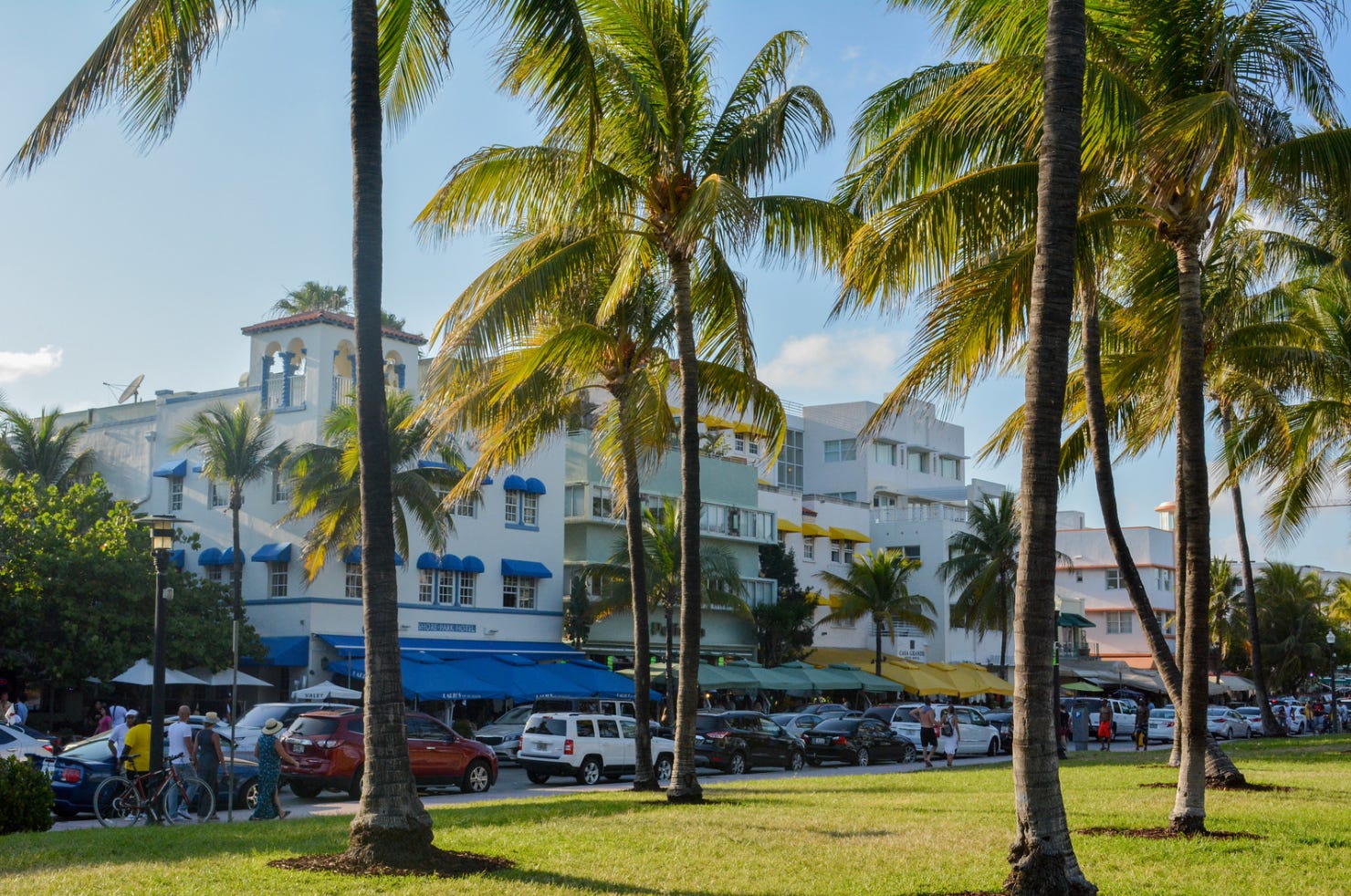
“It’s the only place it’s still going on,” writes one of the authors about the American city most connected to anticommunist intrigue. This short, highly readable and heartfelt study of Miami in the Cold War, by a director at the National Cryptologic Museum and a SOUTHCOM Cuba hand usefully pulls back some of the maximal claims about U.S. government involvement in the plotting, coups and counter-coups of Latin America.
The book is timely given the escalation of pressure by the State Department against Cuba, but a few of the other more subtle themes make it even more so. The authors highlight Castro’s use of mass migration as a political weapon against the United States, which he did three times in the course of his personal rule over the island; the Camarioca and Mariel boatlifts, and most recently during Bill Clinton’s presidency.
Another theme is the failure of communication tools, which is something I’ve been thinking a lot about lately because of the situation in Iran. Our ability to microtarget people has never been better, but there’s the chance of giving them a false impression of the situation and how soon help is coming. I wonder if people are being sent out into the streets on behalf of the exiled Shah to get themselves killed. The cases in this book have more to do with a failure to penetrate because people don’t have radio, televisions or Internet access; the authors go over the radio broadcasts in Guatemala before the 1954 coup, and the record of broadcasting to Cuba is dismal despite the patronage jobs it creates and how it makes Americans feel.
This book is a study most of all of the the specific interactions of the U.S. government with anticommunist exiles in Miami, and some of the more lurid accusations as to these relationships are either debunked or go unremarked upon. It’s often assumed the CIA’s work with Cuban exiles meant all their wild behavior was either directed or condoned by the U.S. government, but this book shows that’s not really the case. Very often the Cuban exiles have been much more gung-ho about overthrowing the communist government than the government, to include flyovers, raids of the Cuban coast, and various other acts which violate the Neutrality Act.
The authors depict the Bay of Pigs failure in these terms. Arthur Schlesinger suggests that the White House might consider deposing both Castro and Trujillo at the same time, just for balance, and Allen Dulles tells Kennedy the operation can’t be called off without really upsetting the exile community, which was ready to go. Miami was the first and only city in the United States with State Department offices and a full CIA station, and the authors write the CIA was possibly the largest employer there in the 1960s.
This part of Cuban history, along with the Cuban Missile Crisis, is very well known, but the story of what happens thereafter is more interesting. By the early 1970s more Cubans begin to take U.S. citizenship, and become a powerful lobby. Around that time also, the authors write about Cubans making their way into the financial infrastructure of the city which allowed them access to credit to start small businesses.
It was not exactly routine, but the number of attacks on shipping to Cuba by exiles is not trivial. Presumably today there is no need to do so because we are enforcing an embargo with the U.S. Navy and State Department. The main culprit linked to these attacks was Orlando Bosch, who the FBI suspected of planning multiple bombings of ships flagged with Cuban trading partners. One of the anti-Castro paramilitaries attacked a Soviet freighter in the Caibarién port two years after the failed Bay of Pigs invasion. That was the incident which prompted the White House to crack down on Cuban freelancing, and is the source of the break which some point to for anticommunist frustration with the Kennedy administration.
Some of these militants were made productive, including in the Congo, where anti-Castro Cubans got into a firefight with Che Guevara on Lake Tanganyika. Iran-Contra was planned in Miami after Congress banned further support for the Contras. For the most part the anticommunist exiles were taken advantage of by a larger scheme with profit as the object.
In the final section, which goes over things like the Ana Montes case—the most damaging Cuban spy in U.S. history who was a lefty-sympathetic UVA graduate—the authors register justifiable displeasure with the Netflix special on the Wasp network, which falsely portrays Brothers to the Rescue as a militant organization whose planes were shot down in Cuban airspace when neither is true. The show had Ana de Armas in it, and the events shown in it are currently the subject of a debate about whether to indict Raul Castro over the shootdown by the Cuban Air Force of two their planes.
While there is a brief section on the Russian influence in Miami’s Sunny Isles, the presence of the Russian issue in South Florida, and the Israeli one, are somewhat undercovered. Some of the Israeli art students deported after 9/11 were in Miami. And the Israeli role in Miami real estate is at least as prominent today as the Cuban one was in the 1970s. But their publisher probably would have made them cut that.