

The Battery Wars
Notes on "The Elements of Power: A Story of War, Technology, and the Dirtiest Supply Chain on Earth," by Nicolas Niarchos
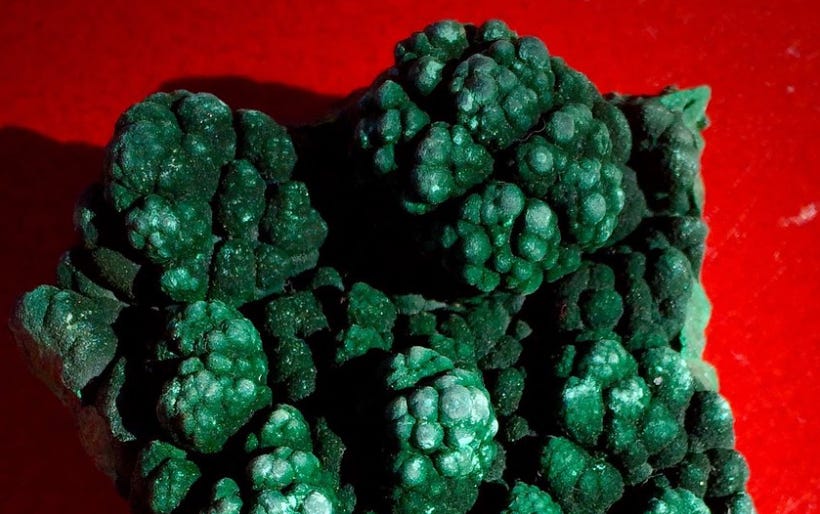
This is the second really good mining book I’ve read in the last couple of years, the other is The War Below, by Ernest Scheyder, which I’ll put up a review of soon. Everyone on the left should read both of them, because you can’t have a Green New Deal without the kind of resource extraction in both of them. Before the battery revolution, humanity used cobalt primarily to colorize glass. There are recent studies that show tailings from metals mines and acid mine drainage in Pennsylvania have cobalt concentrations comparable to deposits in Australia and Russia. But this book focuses mostly on Katanga, which has the highest grade cobalt found anywhere in the world and meets most of the world’s market demand.
There is an implicit foreign policy of the Green New Deal, which anti-imperialist left-wing streamers and activists seem not to really think about. I saw Fergie Chambers on a stream recently talking about how every American has an obligation to help dismantle our own imperialism, and Hasan Piker has said he favors the Chinese social model. This is loser shit, and won’t lead to a good outcome for the Africans and Southeast Asians they claim to be speaking for.
Pull back the ideology 50 percent and start there instead. The author of this book gives as much due to the humanitarian perspective as anyone might be expected to, but he’s very pragmatic to be clear that the green revolution implies more mining, and of the kind of stuff they pull out of the ground in Katanga. It does need to take place for different materials than the resource extraction at the core of our Middle East policy since the Second World War. The classic Republican move when they get to the White House is to let the oil and gas industry rip, but that has probably had its last run with this administration. It’s not necessary to get into a lot of arguments about the science of global warming to think this is a good thing. It’s better to work on new stuff.
There really are a couple of either-or choices, and we have to choose both of them correctly. We can either bet on a more or less exclusive petrochemical economy which implies a permanent presence in the Middle East, or we can do something else. And if we choose the latter, these supply chains will either be dominated by the West, which however flawed is much more committed to fair labor practices and democracy, or they will be dominated by China. These conflicts are already happening; Africa is a battlefield, and a strictly anti-Western anti-imperialism effectively gives cover to a much harsher Russian and Chinese domination. Erik Prince trained the guards at the Chinese mines, if that helps make the point.
Niarchos’ sympathy toward the sorely abused Congolese—abused as often by their own government as by others—is no doubt a big selling point about this book for a lot of people, but the biographical detail of some of the new Chinese minerals barons sticks out to me. Especially Wang Chuanfu of BYD, the battery company which would have beaten Tesla already were it not for the tariffs, and Chen Xuehua of Huayou, the mining company that makes up the main Chinese presence in Katanga. These are two of the main beneficiaries of the stepped-up Chinese presence in Africa in the 2010s after the U.S. ceded the continent in favor of pointless wars in the Middle East. By then the previous leader of lithium-ion battery production, Japan, which improved on Exxon’s original with the stabilizing addition of lithium cobalt oxide, had ceded market share to Samsung and BYD. By 2012, Sony had moved its battery division to the mainland. “We invented this technology and then we lost it,” he quotes one Japanese saying.
During the Cold War, the civil wars in Congo and Angola were two places where the Soviet Union and China were genuinely at odds from time to time, with China tending to be much more pragmatic. They backed both sides of the Angolan Civil War. China’s role in the Congo, Niarchos writes, goes back to the 19th century, when it was the only African country the Qing government signed a treaty with. For reasons of communist ideology, they were enthusiastic about Lumumba, but decided they could work with Mobutu.
There is also great detail in here about the mercurial Dan Gertler, the son of an Israeli diamond trader who has been sanctioned and de-sanctioned by successive U.S. administrations. He arrived in Congo after the fall of Mobutu and quickly gained a big fat diamond concession. According to the former charge d’affaires in Congo in the 2000s, quoted here, Gertler worked with the Israeli military in the country, and it’s now public record that the head of Mossad visited the country with him. “Glencore was the last non-Chinese or non-Kazakh major owner of copper-cobalt mines in the greater Katanga region” by 2018, Niarchos writes. The best detail in here about Gertler, which I hadn’t seen before, is that Amos Hochstein, Biden’s energy guy, favored de-sanctioning him, using that classic line Israelis hype themselves up to Americans with: “He’s got the experience, and he’s tough. Americans aren’t so tough anymore.”
Gertler is exactly the sort of guy those who want to integrate the U.S. and Israeli defense infrastructure have in mind. Here’s a major cobalt baron in an area where only Russia and China are the other players. Why don’t we bring him on board? The problem is he’s a crook. And this way of doing business has the potential to undercut more lasting resource development at a higher standard with actual treaty allies.
Resource extraction for high-tech manufacturing is pretty important to our alliance structure. Mark Carney is benefitting from a wave of anti-American sentiment in Canada because Trump is unpopular there, but it will swing back. Here’s why: Both Australia and Canada are resource colonies, which is the underlying economic reason their governments take an interest in human rights abroad. Every mine cutting corners on substandard safety protocols is undercutting theirs at home. China is famous for this. What we’ve seen under Trump by contrast is, what if we just work with the Chinese and Russians, as the Israelis already do? That’s really problematic for our NATO allies, and not just because they’re snooty Europeans.
By the end of the period covered in this book, the only producers in Katanga, by far the most important cobalt-producing region in the world, are Chinese, Kazakh (really Russian), and semi-Israeli (but getting less so). None of these countries are known for their humanitarian scruple, which matters when other countries with exploitable cobalt reserves, for instance, are Canada, Australia, and Cuba. Policing bad actors in the Congo, or in European and American courts, makes it possible for prices to rise high enough for reserves in countries with better standards to be exploited. There are sometimes difficult choices where humanitarianism has to be sacrificed, but this is an example of a place where humanitarianism and economic strategy go together.
The U.S.’s giveaway of Africa in favor of the Middle East has a lot of different pieces. The Biden administration, to its credit, tried to contest pieces of it again. The centerpiece was what they called the Lobito Corridor, really rebooting the Benguela Railway, which would allow the exportation of copper and cobalt westward, through Angola, instead of through Zambia to the East and South. One of the reasons the Benguela Railway stopped working, and Niarchos doesn’t spend much time on this, was Jonas Savimbi, a Paul Manafort Client and Heritage Foundation cause celebre. You can see why the eastward exportation might be favored by the Chinese and Israelis.
High humanitarian standards for mining, the Lobito Corridor, supporting Japanese efforts in Southeast Asia, and developing secure domestic and allied operations is the U.S. play. Trump is not doing a good job moving this forward, in fact he seems to mostly be giving away the farm while pretending he’s making great deals.
Anyway, this book gets my gold star. It’s probably even more important than Chip War, which everyone was talking about a year or two ago in DC. A thought worth passing on about the Congolese:
“My working hypothesis about Congo, formed over some four years of writing about the country, was now being proved in the most terrifying way—namely, that people had been gaslit, lied to, and repressed for so long that their senses of reality had been irretrievably warped.”
In that, many people around the world are in the same boat.
Thanks for reading and engaging with the book so carefully!