

The Book Smugglers
Notes on "The CIA Book Club: The Secret Mission to Win the Cold War with Forbidden Literature," by Charlie English
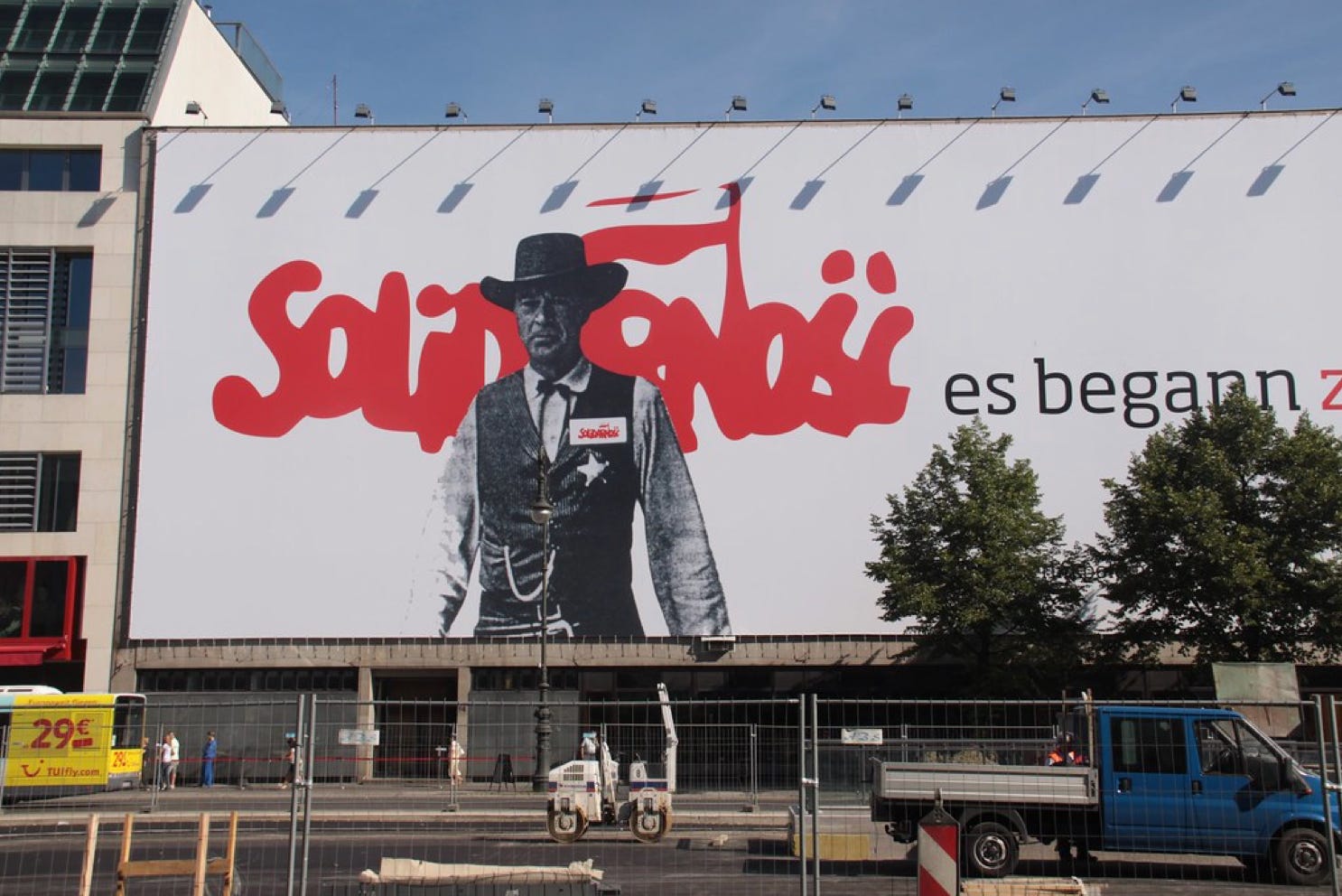
There is a character in this book the way the sea is a character to Edna Pontellier, the natural reference point which shapes behavior, except it is not a force of nature at all. The regime is a mass noun. Every member of the militia and secret police of the Polish communist state had a mother and father, had friends as a child, maybe fell in love, was hungry sometimes, had hopes and dreams, was occasionally happy and sad, and in between all that they censored, repressed, and cracked the skulls of their countrymen for a paycheck. But they are nameless and faceless here.
It’s not Mr. English’s job to introduce them to us because this book is about the heroes, not the villains, but one wonders generally, when shall we meet the censors? When shall we meet the wielders of communist truncheons, and the jammers of feeding tubes by which hunger strikes were broken? I would like to know more about the censor with his own secret library—for monitoring the underground, of course—who spirited away copies of Solzhenitsyn, Orwell, and the rest in a communist version of a pastor with a stash of nudie mags.
There’s a whole industry dedicated to keeping 90-year-old Wehrmacht veterans from their bingo, and very little in the way of truth and reconciliation for the Warsaw Pact’s mechanisms of repression. Why is that? However far we may be from that blessed consummation when justice and mercy shall kiss, are we, here in this vale of tears, permitted to wonder if there has been too much mercy and not enough justice in this instance? Is there a double standard here?
To ponder this for a while leads to a disturbing assumption: that they are probably not so unlike us. They are certainly not so unlike the grey bureaucrats who, for a good 20 or 25 years, imagined they had Europe in hand from Brussels. In some cases, at least according to Ryszard Legutko, they are the same people, which explains much.
This book is about how the CIA supported free thought in Poland by smuggling books, or underwriting the printing of smuggled books, books which then had to be smuggled internally among readers, mostly during the decade of heavy absurdity between the Gdansk shipyard strike and the end of communist rule, when Poland was a workers’ state that had ceased to speak for the workers.
To get a feel for the intellectual climate of Poland under Soviet suzerainty, think of a liberal arts college over the last ten years, or a media company or New York publishing house, with exactly the same, near-superstitious aversion to free thought clearly expressed. Just imagine you’re carrying your “reactionary propaganda” in a false-bottomed truck across the Iron Curtain instead of having your posts policed by people on the Internet. In those days you’d have to worry about prison, today if you’re caught with the same they’ll just make sure you never work in education or the public sector.
I’m not being facetious. People who lived through this are still around. Ask them and they will tell you it feels the same way. Have you not heard of the reactionary judges standing in the way of the people’s fairness referendum, comrade? Why would you ever want to take down the “anti-fascist protection barrier” running through Berlin? Woe to him that calls evil good, and good evil—there has always been a recognition that these sorts of inversions are spiritually harmful, characteristic of wickedness. They harm the spirit because they harm the reason by which human beings relate to one another.
At the risk of being too pointed, many in the U.S. would call the independent publishers and book smugglers of communist Poland disinformationists. One of the pieces of disinformation the official censors kept from the pliable minds of the Polish people was, says English, “a book about growing carrots,” which was “destroyed for implying that vegetables could sprout individuals’ gardens as well as in those run by collectives.” And yet they sprout, you can imagine Galileo saying.
There are several stages of activity, the last of which was Reagan’s authorization of covert action after martial law was declared to help Solidarity. But the well-known book program had been operational for a long time before that. Most of the authors associated with the program are household names: Milosz, Orwell, Solzhenitsyn, Günter Grass, Kurt Vonnegut. We think of these names as fairly tame today, which probably says more about the intellectual climate their works arrived in. The CIA officer who managed the program conceived of it not as a targeted propaganda campaign, but as “an offensive of free, honest thinking and accurate information.” The older generation of Polish exile patriots like Jerzy Giedroyc, who participated in the Congress for Cultural Freedom and was a CIA asset, helped the younger generation set up their own publishing operations come the 1980s.
Under the communist regime, independent publications were proscribed, and publishers were one of the most common targets of regime repression. In the mid-1980s more than 300 Polish independent publishers were political prisoners. During the period of martial law in the early 1980s, you needed written permission to use printing equipment.
The three central institutions of the Polish resistance were Solidarity, the Church, and the independent press, and the CIA supported all of them at various times. Some of this has been declassified—it was believed the Jaruzelski regime would use the murder of Fr. Popieluszko to cut the hard-liners loose, as he had only imposed martial law reluctantly and out of fear Moscow would intervene directly.
By a long stretch the support for independent publishing and book smuggling in Poland was the most successful CIA covert operation against the Eastern Bloc of the Cold War, and also comparatively cheap. The book program was supported by Zbigniew Brzezinski and counted the future Pope John Paul II as a correspondent. Polish-born Richard Pipes was a big backer who knew Miroslaw Chojecki, Solidarity’s minister for smuggled literature. George Soros bought printing equipment.
Censorship in the communist world was a Pandora’s Box problem. By the 1980s, the official censorship had ceased to be effective, so everyone had the sense they were being lied to. “A third of all Poles had access to Solidarity publications” by 1981, English writes. The second legalization of Solidarity was the end of the regime.
That censorship, the official withholding of information, often backfires is a lesson schoolchildren learn, but that its opposite, propaganda, the official dissemination of information, often does the same is harder to appreciate, but you can see it in this story. English writes that the entire exile community had been tarred as CIA assets, so whatever truth there was in the matter was dismissed by most people, if their help was not welcomed. And constant warnings about conspirators gave the term conspiracy a neutral if not positive connotation which it doesn’t have in our own time.