

The Parson's Cause
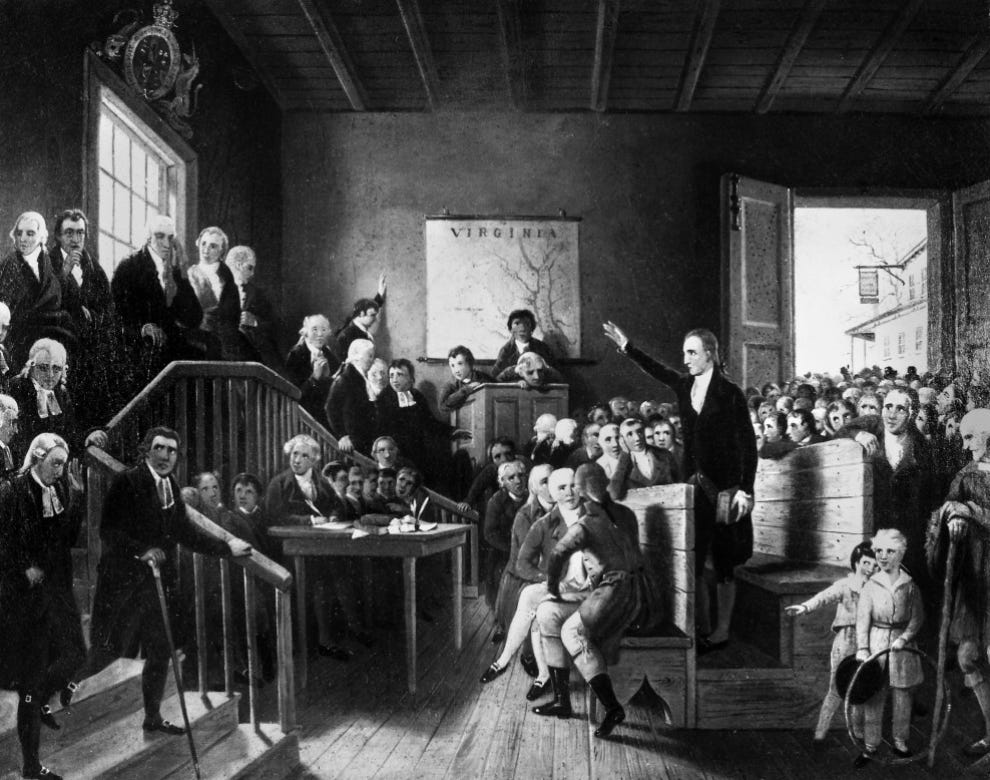
Hanover County Court House, Virginia, December, 1763
“He who takes the king's shilling at the altar
must not weigh it against the people's grief.”
—heard in the courthouse yard, unrecorded
I. The Drought
In the year the tobacco withered in the field,
when the red clay cracked its lips along the James
and the broad leaf yellowed before the August sun
had turned to do its merciful harm—that year
Virginia made a law of its necessity.
The Assembly spoke: let debts in leaf be paid
in coin, at the old rate of two pence the pound,
for one year only, while the land recovered.
And so the clergymen were to receive in silver
what the drought had made impossible in weed.
Two pence the pound. The parsons thought: too little.
The market price of leaf had climbed to six.
II. The King’s Veto
Across the sea, in London’s counting rooms,
the Board of Trade deliberated, and found
that colonies must not amend what crowns have fixed.
The royal disallowance crossed the water
like a wind that does not know the ground it cools—
ignorant of drought, of clay, of hungry children,
ignorant of what necessity had made.
The king had bent, or bent by Whig advisors bent,
to strike the colony’s relief aside.
And so the parsons went to law. Reverend Maury
of Fredericksville—a learned man, a fair one—
stood first to claim his six pence in the courts.
The law had said he won; the question left
was only what the jurors ought to pay him.
III. The Young Man Rises
He was not thirty years. His father sat
upon the bench—a magistrate, a Henry—
which would have been, in any other case,
an awkward office. But the son stood up,
ungainly as a heron on the shore,
and something altered in the room. The air
drew back, and those who came to watch the law
transact its business, leaned upon their heels.
He was, they said, a failed shopkeeper once,
twice failed, before he read the law alone
in months—a season—less. A man of fields
and taverns, some supposed; a man who knew
the price of corn, the weight of common grief.
And when he spoke, the courthouse heard a thing
that it had not heard before in any tongue:
the argument of nature, dressed in law.
IV. The Argument
He turned—and this was bold—he turned the case.
The parsons had won judgment, yes; but what
is law that stands apart from obligation?
A king, he said—and here the room went still—
a king is bound by compact to his people.
He holds his covenant. Should he dissolve
the laws by which a suffering people cope,
he breaks the bond, and forfeits love for duty,
and those who suffer under such decree
are freed—hear this—are freed from their allegiance.
A tyranny of vetoes, even one
dressed in the cloth of church, is tyranny still.
The parsons in the gallery cried: treason.
He did not stop. He widened the indictment.
V. God and Virginia
For this was not a contest merely of
the market price of leaf against the canons—
though that was real enough, and hungry enough.
Beneath it lay a question of two rights
that could not share a throne: the rights of God,
as held by men in vestments, backed by Crown,
and standing independent of the land;
and those of Virginia—earthen, rooted,
slow-grown as tobacco in a dry year,
belonging to the men who plant and sweat
and meet in courthouse shade to make their laws.
Which sovereign would be obeyed? Which compact held?
The parson’s stipend, fixed in distant London,
or the Assembly’s mercy to its own?
VI. The Irony of Providence
And here is what the mind returns to, after:
that God’s own servants, pleading God’s own right
to what the harvest owed them, made the case
by which Virginia learned to think as free.
Had the tobacco grown—had that one summer
given leaf enough to fill the Anglican tithe—
no crisis would have come; no two-pence act;
no veto from the Board; no Maury sued;
no young man risen in his father’s court
to name the king a tyrant and be heard.
The drought—dry, mindless, no respecter of creeds—
became the instrument of something vast.
Nature, indifferent, set the stage entire.
VII. The Verdict and its Weight
The jury gave the parson one penny damages.
One penny—not contempt, they said, but judgment.
Maury walked from court a poorer theologian.
The crowd outside received their advocate
upon their shoulders, in the winter light,
and something that had lived in the colonial mind
as grievance, or as fear, or as suspicion
that distant power did not know its subjects—
that something now had words. And having words,
it could be thought; and being thought, would grow;
and growing, ask itself, by winter fires
in Hanover and Albemarle and beyond,
whether a king who breaks his bond deserves
the loyalty of men who break their land.
VIII. The Long Consequence
Twelve years would pass before the shot was fired.
Much water still to cross, much ink to dry.
But those who heard him in that Hanover court
would not forget what it had felt like—once—
to hear the argument of natural right
made plain and loud as thunder, and to feel
that it was true, and that they had a claim
upon the world their fathers never named.
Revolutions do not begin in arms.
They begin in courtrooms, in a dry year’s drought,
in a parson’s penny and a young man’s voice
that asked what any sovereign truly owes
the people who have given him their faith—
and answered, before anyone was ready,
that sovereignty is a gift, and gifts are mortal.